

UCAS 2026: Key Dates, Deadlines, New Personal Statement Questions & Clearing Guide
Short answer: The equal-consideration deadline is Wednesday, 14 January 2026 at 18:00 (UK time). Clearing opens on 2 July 2026, with late-cycle milestones continuing through September and October. This guide turns dates into decisions, so you always know what to do next.
Applying to university shouldn’t feel like a maze. This professional, plain-English guide distils the UCAS 2026 cycle into a clear plan: the dates that matter, the actions those dates demand, and the new personal-statement format that levels the field. You’ll also find a five-choice strategy that prevents common mistakes, plus scripts for Results Day and Clearing so you sound prepared, confident, and credible on the phone.
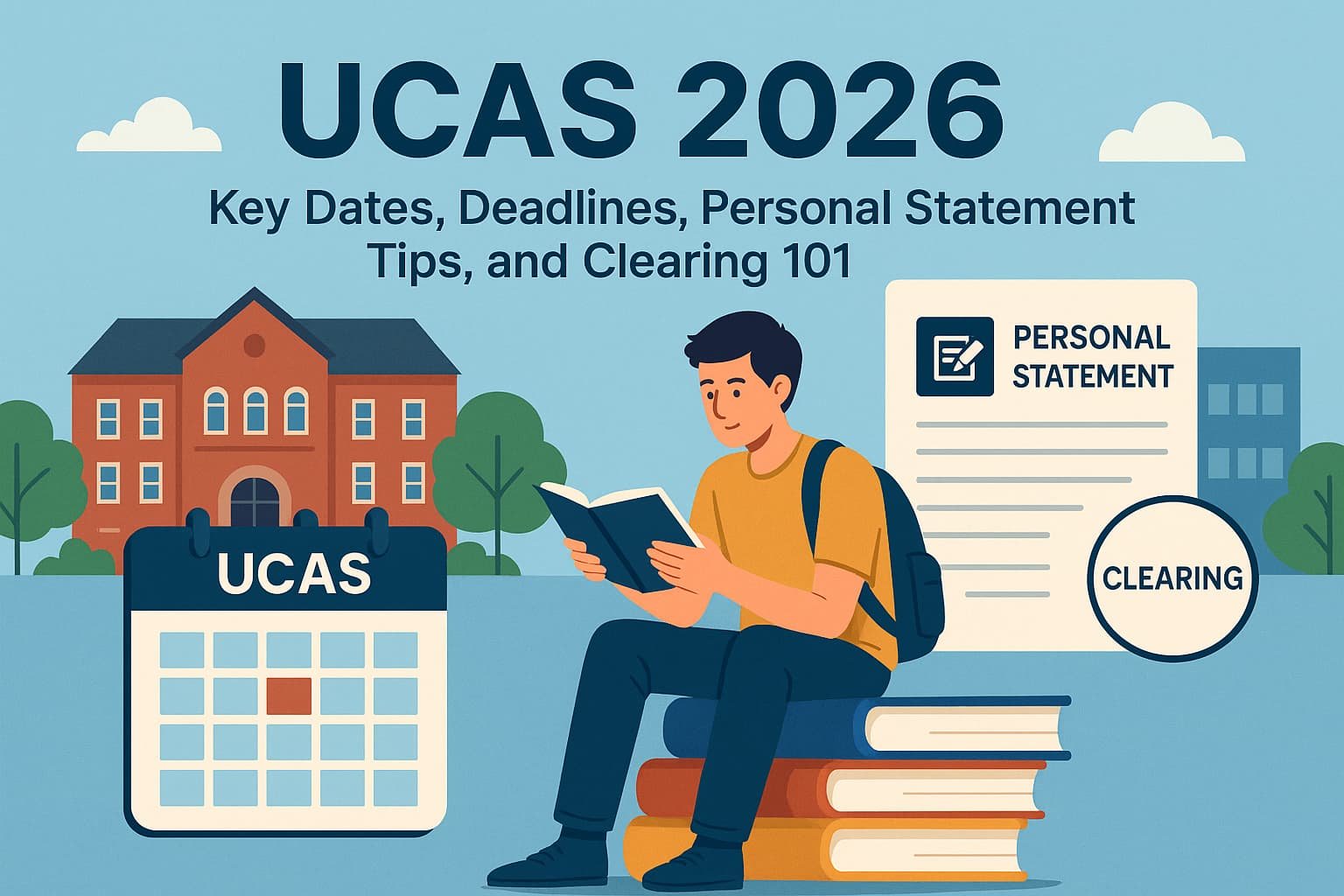
UCAS 2026 at a glance (bookmark this)
- 14 Jan 2026Equal consideration Submit by 18:00 (UK time) to secure equal consideration. Ensure your referee has submitted their part; your application can’t be sent without it.
- 31 Mar 2026Advisory deadline A helpful “decision-making” nudge; universities move many offers by now. Use the date to plan replies, campus visits, and finance applications.
- 2 Jul 2026Clearing opens Vacancies appear in the UCAS search tool. If you’re eligible, you can self-release into Clearing or explore options proactively.
- 24 Sep 2026Final applications Last date to submit applications for 2026 entry by 18:00 (UK time). Useful for late deciders and career-changers.
- 19 Oct 2026Final day to add a Clearing choice in Hub. Administrative tail-end; use it only if your plan requires a later switch.
The new 2026 personal statement: three structured questions
From 2026 entry, the single 4,000-character essay is replaced by three focused questions. The change aims to make expectations clearer and reduce the advantage that comes from access to extensive private editing. Treat each answer as a compact, evidence-based paragraph, then join them with brief transitions for flow.
Q1 — Why this course or subject?
Micro-prompt: “spark → exploration → problem I want to solve”.
- Anchor your interest to a precise subtopic (e.g., behavioural finance within Economics).
- Name one meaningful input — a book, paper, experiment, or event — and what you learned.
- End with a forward-looking sentence that links to first-year modules.
Q2 — How have your studies prepared you?
Micro-prompt: “module → skill → result → proof”.
- Translate syllabus lines into skills (e.g., “A-level Biology: experimental design, statistics, lab safety”).
- Quote one measured outcome (competition placing, project grade, lab report result).
- Explain why the skill matters in first year (seminar participation, labs, studio critique).
Q3 — What else have you done outside school?
Micro-prompt: “experience → insight → action”.
- Choose quality over quantity: a sustained volunteering role beats six short tasters.
- Make the link explicit (e.g., “shadowing in A&E taught concise note-taking and calm triage talk”).
- Close with how you’ll contribute to the cohort (societies, peer mentoring, outreach).
Choosing five UCAS options strategically
A professional selection looks like a portfolio: two reach choices (ambitious), two matches (probable offers), and one safety (solid). That balance protects you from single-point failure while keeping your best-case scenario alive.
20-minute checklist
- Confirm prerequisites and any admissions tests for each course.
- Check if contextual offers apply to you (provider policy pages).
- Write a two-line rationale for each choice; it helps referees tailor comments.
- Scan first-year modules — you’re applying to a curriculum, not a brand.
Common pitfalls (and fixes)
- Five identical long shots → diversify with genuine match/safety options.
- Ignoring module load → compare assessment types (exams vs. coursework) to fit your strengths.
- Late reference → agree a timeline with your referee and share bullet points they can verify.
Results Day & Clearing: your professional playbook
Clearing is not a consolation prize; it’s the formal process that matches motivated applicants with remaining places. It opens on 2 July 2026 and stays active across the summer, with final administrative deadlines stretching into October. Preparation now shortens calls later.
Prepare now
- One-page CV: subjects, predicted/achieved grades, standout modules, succinct skills.
- Two micro-answers: “Why this course?” and “What will you bring to first year?”.
- Have your UCAS ID, email, and phone ready by the handset on Results Day.
Professional call script (edit to your tone)
You: “Hello, I’m calling about Clearing for [Course]. My UCAS ID is [ID]. I’ve achieved [grades] and especially enjoyed [module]. Could you confirm if there are places and whether my profile fits what you’re looking for?”
University: “Tell us more about your preparation.”
You: “Alongside A-levels, I completed [project/experience] which developed [skills]. I can email a concise CV and statement today. What are the next steps if I receive a verbal offer?”
Week-by-week actions (from now to January)
Weeks 1–2: foundation
- Draft answers to the three personal-statement questions.
- Shortlist 7–8 courses; shape your five using reach/match/safety.
- Speak to your referee early; the application cannot be sent without their part.
Weeks 3–4: polish
- Trim each answer to ~140 words; add one proof point each.
- Replace generalities with specifics (titles, dates, outcomes, numbers).
- Mock a mini interview: two minutes on “Why this course?” with a friend or teacher.
Final 10 days
- Re-check provider pages for any updated entry criteria or test dates.
- Run a fresh proofread; confirm contact details in Hub; submit before 14 Jan 2026, 18:00 (UK).
Need expert help today?
If deadlines are closing in or you want a professional check on wording, our UK-based team can review personal statements, polish academic writing, and help you produce high-quality coursework on tight timelines.
Fast personal-statement feedback, last-minute assignment support, and weekend turnarounds — trusted by students across the UK and beyond.
UCAS 2026 FAQs
What is the equal-consideration deadline for 2026?
14 January 2026 at 18:00 (UK time). Providers must consider all applications submitted by this time equally.
What changed about the personal statement?
One essay has been replaced by three structured questions on motivation, readiness, and engagement, with clearer guidance for all applicants.
When does Clearing open for 2026 entry?
2 July 2026, with vacancies listed in the UCAS search tool.
What are the late-cycle deadlines?
Final applications close 24 September 2026 (18:00), and 19 October 2026 is the last day to add a Clearing choice.
Can I apply after 14 January?
Yes, but you won’t receive equal consideration. Late applicants may still be considered if places remain or via Clearing.
How are A-level/GCSE grade boundaries set?
After marking, exam boards compare cohort data with prior years to maintain standards. Check each board’s Results Day publication.
Your article helped me a lot, is there any more related content? Thanks!
Thanks for sharing. I read many of your blog posts, cool, your blog is very good.
Can you be more specific about the content of your article? After reading it, I still have some doubts. Hope you can help me.
Thanks for sharing. I read many of your blog posts, cool, your blog is very good.
Thanks for sharing. I read many of your blog posts, cool, your blog is very good. https://www.binance.com/pt-PT/register?ref=KDN7HDOR